The business world no longer speaks in straight lines. If five years ago we still considered volatility an anomaly, it is now the baseline. The currents of change—from technological disruption, shifts in consumer demographics, to the reconfiguration of global regulations—have transformed the competitive landscape into a fast-moving and noisy battlefield. Here lies the greatest paradox for Founders and the C-Suite: the more data available, the harder strategic decisions become.valid.
This article is designed not to give you empty motivation, but rather an operational framework that you can immediately use to turn uncertainty from a threat into acompetitive advantage. What will you gain from this reading? A decision validation system that separates signal from noise, a roadmap to ensure every capital allocation works smarter, and a perspective on how to integrate operational intelligence with leadership intuition so that thestrategic partnershipyou build generatesexponential leverage, not just a slow mutualistic symbiosis.
When Intuition Is No Longer a Reliable Map
Let’s talk data, because numbers know no loyalty or ego. In a recent survey of over 2,000 organizations across the Asia Pacific, it was revealed that only 31% of strategic transformation initiatives successfully achieved their initial ROI targets. This figure is not just a statistic; it is awarning lightflashing on the dashboard of companies across Indonesia. Why? Because the gap (gap) the gap between strategic plans on paper and reality on the ground is widening.
Founders and CEOs are currently facing threemain pain pointsthat are interlocking:
Analysis Paralysis:Decision-making is stalled due to being overwhelmed by conflicting data.
Operational Rigidity:Rigid strategies fail to adapt when external variables change in weeks, not years.
Scalability Trap:Accelerating growth without strengthening governance foundations, which ultimately leads tooperational technical debtand hidden margin leaks.
Uncertainty cannot be eliminated, but its impact can be measured and managed. Organizations that survive and excel in 2026 will not be the largest or the oldest, but the mostagilein validation—those capable of pivoting without losing momentum. Those who succeed are those who understand thatstrategic growthis not about predicting the future, but about building systems that continuously test assumptions and adjust direction with surgical precision.
Deconstructing the Framework: From Assumptions to Validated Execution
To build a relevantIndonesian founder playbook for 2026,we need to dissect three main pillars that form the foundation of strategic resilience. This is not management theory plucked from old textbooks, but a synthesis of patterns that have been successfully tested in the field.
1. AI Governance Architecture as the Decision Center
Artificial Intelligence (AI) has passed the phasehypeand is now entering the operational integration phase. However, this is where the biggest trap lies. Many companies adopt AI as a "magic tool" without equipping themselves withsolid AI governance. Without governance, AI is just an automated bias generator—fast, but potentially leading you to the abyss with high efficiency.
Effective AI governance is not just about compliance (compliance) or data ethics; it is aboutinput validity and output consistency. In the context ofstrategic decision-making, AI should function as aco-pilotthat challenges human assumptions, not ayes-manthat confirms cognitive biases.
Practical Applications:
Regular Algorithm Audits:Before integrating AI outputs into investment or recruitment decisions, conduct astress teston the model. Is the training data representative? Are there anydemographic or historical biases that could distort predictions?Human-in-the-Loop (HITL):
No high-risk strategic decision should be made fully automated. Set human intervention points where leadership intuition (leadership intuition) meets data recommendations. AI provides probabilities; humans provide context.Controlled Data Democratization:
Demokratisasi Data Terkendali:Ensure AI insights are accessible tostakeholderswithout compromising security. Internal data transparency accelerates the feedback loop and allows for strategic corrections before issues become crises.
2. The Dynamics of Strategic Partnership as an Asset Multiplier
In an interconnected business ecosystem (silos) are a form of vulnerability. However,strategic partnershipsare not justnetworkingor surface-level collaboration. They are a deliberate merging of complementary capabilities to create value that cannot be achieved separately.
How to distinguishvaluable strategic partnershipsfrom mere alliances that slow you down?
Alignmentof Unit Economics:Strategic partners must have aligned incentive structures. If your revenue model is subscription-based (subscription) while your partner's is one-off (one-off), conflicts of interest are a matter of time, not possibility.
Complementarity of Capabilities:Look for partners that fill specific gaps in your value chain. If your strength is massive distribution, seek partners with advantages in product R&D or loyalty to aniche community. Avoidpartnershipsthat merely consolidate the same strengths.
Contractual Agility:The world is changing too quickly for contracts that lock you in for five years without a review window. Build a modular collaboration framework that allows for adjustmentsscopeand terminology based on performance and changing market conditions.
Case Analysis:A companyfintechin Indonesia preparing to expand into the secondary market faces high customer acquisition cost challenges (high CAC). Instead of relying ondigitalmarketing that is becoming increasingly expensive, they builtstrategic partnershipsintegrated with the traditionalretailchain in Central Java. Instead of justco-branding, they integrated thepayment gatewayand theloyaltysystem technically. The result: acquisition costs dropped by 40%, and thelifetime value(LTV) of customers increased by 2.5x because the integration created a naturallock-inecosystem.
3. Scalability Based on Iterative Validation
Growth without validation is an illusion. Many companies that appear to be "growing" are burning capital to cover retention leaks or thin margins.Strategic growth playbook for Indonesian founders 2026emphasizes the concept ofPositive Unit Economics at Scale.
This means: every business unit—whether it's a single product, a single customer, or a single region—must demonstrate profitability before you attempt to scale it.
Implementation Steps:
Deconstruct Profitability:Break down your profitability to the most micro level. Where exactly are the margins eroded? Is it in thesupply chain? Customer acquisition? Or service costs?
Pilot, Measure, Scale:Never do a national launch based on assumptions. Use ahyper-local pilot, measure the pre-established success metrics, and only scale up if the data proves the model's validity.
Strategic Redundancy:At scale, a single point of failure is an existential risk. Build redundancy into critical systems—from thesingle point of failure) adalah risiko eksistensial. Bangun redundansi pada sistem kritis—mulai dari supply chainto thetech stack—not as a waste, but as operational insurance.
Why This Approach Works: Validation Through Evidence
You may ask: is all of this just theory that sounds good on paper? Let's look at it from the perspective of data and field experience.
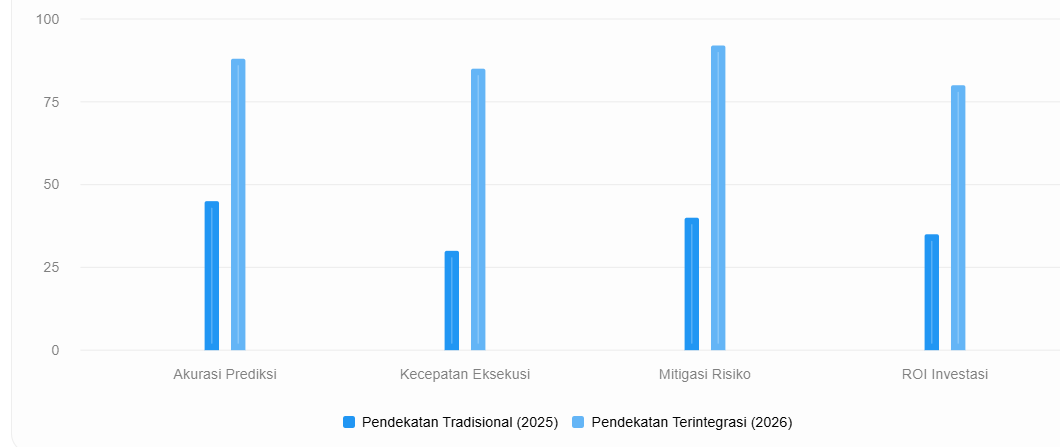
Companies that adopt an integrated approach—combining data-driven operational intelligence with strategic advice from experts who understand the local context—consistently show higher resilience. The graph you see above presents a concrete comparison between companies that still rely on traditional approaches (the status quo2025) versus those who have adopted an integrated framework (preparation for 2026).
Note howthe gapbetween these two approaches is not narrow on one or two metrics, but wide and consistent across vital aspects: predictive accuracy, execution speed, risk mitigation, and ROI. This is not a coincidence; it is the result of systematizing the decision-making process.
At Caelix, we have observed this pattern repeatedly. When a Founder or CEO works in a vacuum, relying on instinct without asanity checkof data, their blind spots become black holes that absorb capital. When they work with anadvisorwho does not understand operations, the recommendations given become unrealistic. However, when human expertise (human advisory) synergizes with automated operational intelligence, what we callCross-Validation: data-enriched intuition, and data contextualized by experience is created.
Concrete Steps: Translating Insights into Action
Theory without execution is hallucination. Here are operational steps you can start implementing this week to strengthen your company's strategic position:
Audit Asumsi Strategis: Kumpulkan tim inti Anda. Tuliskan 5 asumsi terbesar yang menopang strategi Anda saat ini (misal: "Pasar akan tumbuh 10% YoY", "Biaya akuisisi akan stabil"). Tantangi masing-masing asumsi dengan data terkini. Manakah yang tidak lagi valid? Apa konsekuensinya jika asumsi itu salah?
Mapping the Partner Ecosystem:Create a capability matrix for your company. Identify critical gaps—where are you weak or lacking a competitive advantage? Use this map to identify candidates forstrategic partnerships, which are specific and measurable, not just "networking."
Implement Gradual AI Governance:If you haven't used AI in operational decisions, start with low-risk but high-value areas, such as customer sentiment analysis or inventory optimization. Establish AI governance protocols from day one: who is responsible for monitoring, how bias is detected, and when human intervention is needed.
Establish Rapid Feedback Mechanisms:Build a loopdata-decision-outcomethat occurs within days or weeks, not quarters. Your system should be able to signal early when strategies deviate from the path, so corrections can be made before the cost of mistakes becomes unaffordable.
Evaluate Scalability Readiness:Before accelerating growth, conduct apre-mortem. Imagine the worst-case scenario where your expansion fails. What are the most likely causes? Build mitigations for those scenariosbeforeyou make significant investments.
Closing the Gap Between Ambition and Reality
Uncertainty will always exist. The year 2026 will not be more stable than the previous year; it will just have different patterns of uncertainty. The challenge is not to perfectly predict the future—that's impossible—but to build an organization flexible enough to dance with that uncertainty, and strong enough to endure when its rhythm changes drastically.
The journey from a company that reacts to change to a company that leads change begins with one decision: refusing to take steps without validation, and refusing to let data exist without human context. By combining deep strategic expertise, sharp operational intelligence, and the humility to continually test assumptions, you will not only survive in 2026—you will redefine the rules of the game in your industry.
Strategy is not a document kept in a drawer. Strategy is a muscle that strengthens through proper and repeated use. The question is not whether the market will change, but whether you have built a system ready for that change.
Ready to Turn Uncertainty into Momentum?
If you are a Founder or CEO tired of strategic recommendations that feel generic and untested in the field, it’s time to change the way you operate. At Caelix, we provide access to an ecosystemof advisorsand curated operational intelligence, specifically designed for decision-makers who demand precision.
We do not sell promises; we provide validation.